
Industrial product design is the process of turning user needs, technical requirements and business objectives into products that are practical, desirable and ready for manufacture. It sits between research and engineering, helping shape how a product looks, feels, functions and performs.
At Optima, industrial design is about far more than aesthetics. Early design decisions influence usability, manufacturing cost, reliability, performance and ultimately the commercial success of a product.
Good industrial design helps create products that people want to use and businesses can manufacture efficiently. By considering user needs, ergonomics, product architecture and manufacturing requirements from the outset, potential issues can be identified and resolved before they become costly problems.
Effective industrial design can help:
Book a free consultation with one of our experts



















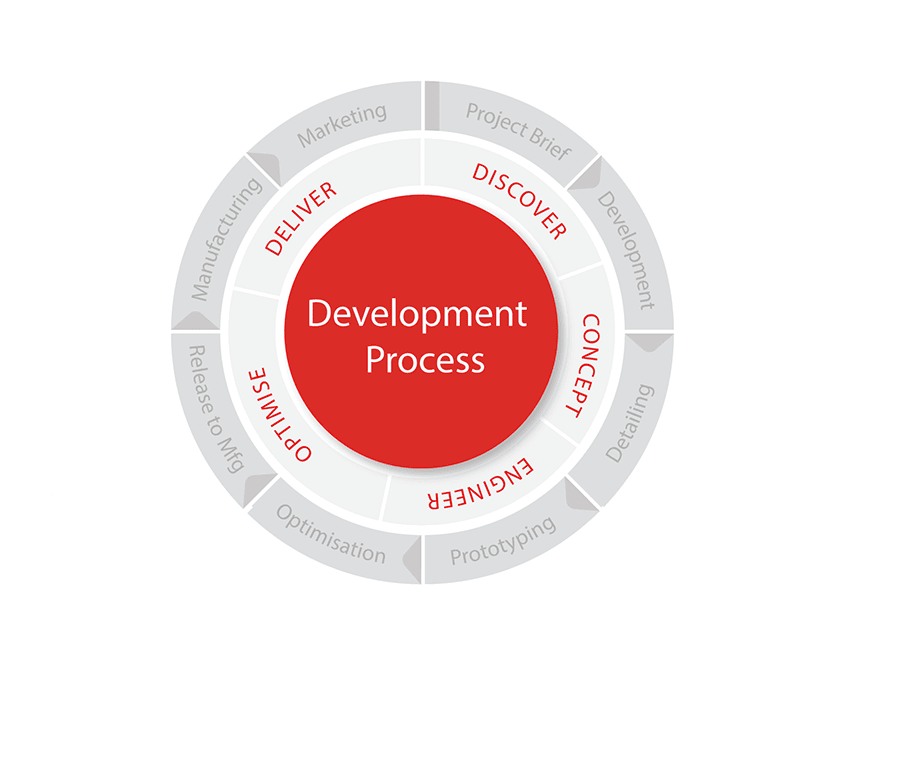
Our industrial designers work closely with engineers throughout the product development process, helping to balance user needs, technical requirements and commercial objectives from concept through to production.
The process begins by understanding your market, users and business goals. These insights form the foundation of the design, ensuring that products not only function effectively but also deliver a positive user experience and meet commercial expectations.
Throughout development, we continuously review and refine designs using realistic visualisations, detailed 3D CAD models, engineering analysis and physical prototypes. This iterative approach helps validate ideas, reduce risk and optimise product performance before manufacture.
Key areas of focus include:
By integrating industrial design and engineering, we create products that are visually compelling, practical to manufacture and commercially successful. Whether you’re developing a consumer product, industrial equipment or a highly regulated device, we can support your project at any stage and continue to provide guidance through production and beyond.
Turning your idea into a product is exciting, but can feel daunting. With so much to think about; like market demand and technical challenges, it’s easy to question whether your product is worth pursuing. Below are a range of commonly asked questions which can help guide your decisions, evaluate the viability of your product and to help make decisions about the best route forward. We always advise engaging with us in the early stages of consideration, so we can support your decisions with our expertise.
There are many factors which can effect the viability of your new product idea. These include; real-world market opportunity, existing products, technical feasibility, risk v’s reward, timescale of development, existence of suitable technologies and availability of funds. We have in-depth experience of gauging the feasibility of new product ideas and can guide the process from assessment of market, technological feasibility, costing and routes to final delivery. Our central focus is to undertake projects which are viable and lead to real world solutions being launched to market.
Yes, we employ a highly transparent, collaborative approach and encourage you to be fully involved in the Design and Development process. Often you hold the key information and learning, which we need to fully understand to develop the best products. We keep our clients regularly updated with progress, challenges and costs by screen-sharing and in-person meetings. We want our clients to feel fully included and happy with the results of any development process.
No, we deal with both new start up’s and established manufacturing businesses. We can provide full-service design and development and complimentary assistance where required. Previous product development experience is not a prerequisite to engage with us in the development of your product ideas.
No, we can work from verbal or written descriptions, or more detailed drawings of a design concept. We always propose a kick-off telephone call, screen share or in person meeting so we can gather as much information as possible about a product proposal, background to the idea, and long term goals. We also offer full ground-up development services and can formulate inventive concept solutions to an existing design problem, which has been identified.
Yes, we follow a standard practice of issuing legally binding Non-Disclosure Agreements (NDA’s) to protect both parties and their intellectual property. This ensures that technical and proprietary information can be shared securely. Additionally, we only collaborate with trusted partners, all of whom are covered by comprehensive NDA’s. We are also happy to review and sign existing NDA’s, should they be required by established companies.
There are several sources of research and development (R&D) funding, depending on industry, location, and project stage. Government grants and incentives, such as innovation grants (Innovate UK, Horizon Europe) and R&D tax credits, help reduce costs and encourage innovation.
National science and research councils also provide funding for academic and industrial projects. Private investment options include venture capital, angel investors, and corporate partnerships, which can offer both funding and strategic support. Universities and research institutions often provide grants for joint industry research, while incubators and accelerators offer funding, mentorship, and networking opportunities.
Alternative financing methods, such as crowdfunding through platforms like Kickstarter or Indiegogo, can help early-stage projects gain traction.
We can offer support and assistance in sourcing Research and Development funding to help develop your product.
Project timelines depend on the technical complexity of the product. Simple designs may take weeks, while complex electro-mechanical systems can require months or even years. We assess technical feasibility, estimate costs and timelines, and identify risks early. Generally, the more unique or intricate a product, the longer it takes to design, prototype, validate, and transition to manufacturing. Solving complex electro-mechanical challenges is an iterative process, often requiring multiple prototypes to ensure reliability in real-world conditions.
Other factors affecting timelines include; market certifications, component availability, manufacturing schedules, and ongoing funding availability.
This is highly project specific and dependent on the type of client we are dealing with, from first time start-up to established businesses. We can provide part, or full-service development, specifically tailored to individual requirements. Common resources required to develop a product include; concept and CAD design, detailed engineering, electronic and PCB development, IP evaluation and consultation, mechanical prototyping and manufacturing specification and liaison. We can advise on resource requirement including offering technical expertise and resource planning, help build the right team of suppliers and offer advice on funding and product delivery.
Almost, always, yes.
Prototyping takes many forms, from simple sketches or foam models to fully functioning electromechanical designs. It is one of the most valuable tools for evaluating and refining a concept. Throughout the development process, we recommend various prototyping techniques and collaborate with specialist suppliers in the UK and the Far East to achieve the best balance of accuracy, cost, and timescale.
Prototyping is crucial in industrial design for several reasons. It helps validate design ideas by allowing real-world testing, identifying flaws early. It also ensures the product meets user needs by assessing ergonomics, usability, and comfort. Prototypes allow testing of materials, manufacturing methods, and performance, making it easier to refine designs through iteration.
A prototype provides a tangible way to visualise the product, ensuring it meets expectations for form, size, and aesthetics. It also facilitates communication with stakeholders, offering a physical model for feedback. Additionally, prototypes reduce the risk of costly mistakes by identifying issues before full production, saving both time and money. Ultimately, prototyping is essential for creating functional, user-friendly, and successful products.
You do. We can help develop solutions which incorporate unique features, applicable to intellectual property registration. You, as the paying client, own the intellectual property of any feature or mechanism which we develop. Where ‘inventor citation’ is required for the Patent Office, we sign an IP transfer document which means that you own, outright, any IP which is integrated into your product. This allows you to exploit, maintain or transfer any IP without recourse to consultation with us. This includes Patents, Design Registrations, Trade Secrets and Trademarks.
The ownership of patents not only gives market Kudos, and confidence to potential investors, but can also open opportunity for governnment backed schemes like The Patent Box. This scheme can provide tax breaks for companies investing in R&D. We can advise on whether your products are applicbale to this scheme, and also help develop unique IP which can open routes to additional financial benefits.
We have strong partnerships with prototyping and manufacturing specialists who handle both development prototyping and final production. We can manage the entire manufacturing process for you or provide supplier contacts for self-management. For established companies, we are also happy to collaborate with existing suppliers or in-house manufacturing teams.
Risks in new product development (NPD) often stem from complexity—the more intricate a product, the greater the risk. Below are key risks that must be actively managed:
Funding Availability – Successful product launches go beyond development. Costs extend to tooling, manufacturing, certifications, marketing, packaging, distribution, and ongoing support. We offer full-service product development, including cost assessments and funding guidance, from innovation grants to tax incentives.
Technology Availability & Development – Most products require problem-solving to ensure functionality and manufacturability. The more complex or unique a product, the higher the risk, especially when integrating intricate components and mechanisms. The most effective approach is often the simplest solution which fulfils the products functional requirement cost effectively.
Insufficient Development & Manufacturing Timelines – Realistic timelines are essential for robust design, evaluation, and testing before transitioning to manufacturing. Production timelines must also account for tooling, assembly, certification, and distribution.
By addressing these risks early, we help ensure a smoother and more successful NPD process.
Emergence of competitive products, or changes to market conditions – In competitive markets, there is always a risk that new solutions may emerge to address similar problems. Timing is often critical to success. Our approach involves assessing market conditions and existing intellectual property while advising on IP protection strategies. This ensures that the product being developed is both valid and capable of solving real-world problems effectively. We partner with specialist IP advisors who can provide services ranging from IP searches, to full patent, design protection and trademark registration.
We are not specialists in the promotion or marketing of products. We can however offer support with packaging, instructions, photo-quality renders, animations and other related marketing materials to assist in funding pitches and promotional material development. We can also source high-quality presentation models which can be useful for marketing photography, stakeholder buy-in, trade show demonstrations and crowdfunding campaigns.
Eaton Cooper Security partnered with Optima to design and engineer a new series of wireless smoke detectors built around a shared chassis and common electronic architecture. The aim was to create a versatile platform that enabled multiple product variants while maintaining cost efficiency, simplicity, and high-quality surface finishes.
Strict safety legislation required the development of reliable mechanisms including button actuation, safety paddles, springs, LED light distribution, and ceiling mounting plates. A key challenge was creating visually distinct products while keeping the core PCB components fixed in position to control costs and ensure compliance.
Machined and rapid prototypes were produced to evaluate fit, function, and performance, enabling refinement of the smoke chamber, light pipes, and button operation. The final detectors achieved a compact footprint and clean aesthetic, integrating seamlessly with an Alarm Base Station while meeting rigorous safety certification standards.
Unit 20 The Courtyard, Maisies Way The Village, South Normanton, Derbyshire, DE55 2DS
View on Google Maps